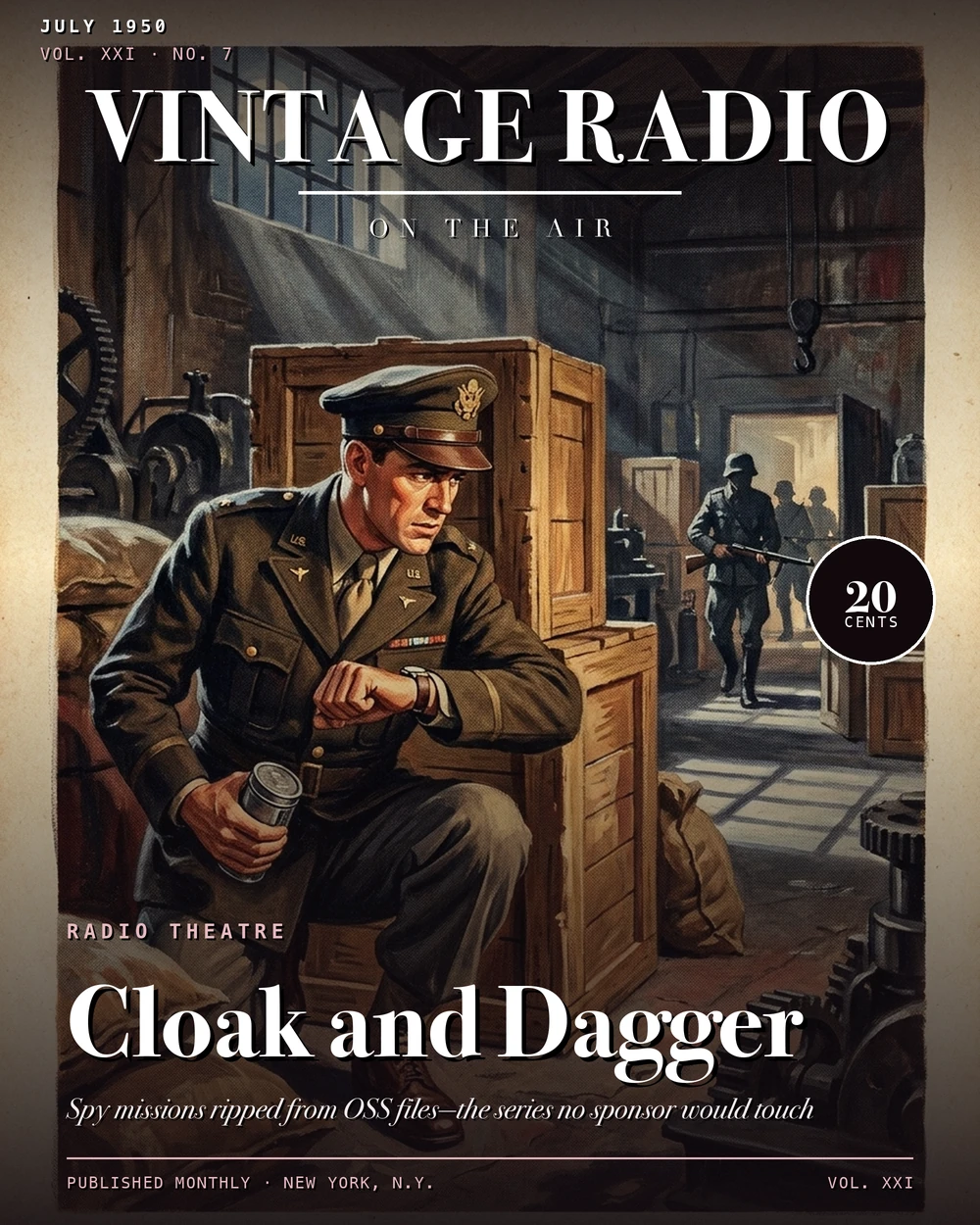
Cloak and Dagger
The Show Nobody Paid For
Cloak and Dagger had the kind of premise that should have drawn advertisers scrambling. It was the first network series built entirely on authenticated case histories from the Office of Strategic Services — America's wartime intelligence agency, the forerunner of the CIA. Each episode dramatized a real mission: agents parachuting behind enemy lines, partisans blowing bridges, operatives running spy networks across Europe and Asia. The stories were drawn from genuine OSS files, and they were as strange and tense as anything a fiction writer could manufacture. Yet the show ran all 22 of its episodes on NBC in 1950 without ever attracting a single commercial sponsor. It aired Sundays at 4, sometimes Fridays, got lumped into a summertime mystery block alongside shows of considerably thinner quality, and received almost no critical attention while it was on the air. It vanished in October without much notice.
What the show actually contained, discovered only after the fact by those who went looking, was something quite different from the filler its timeslot suggested. Every episode took a different protagonist on a different mission, and the outcome was genuinely unpredictable — the agent might succeed, might fail, or might not come home at all. That willingness to end a story in defeat or death, in a broadcasting era that usually demanded tidy resolutions, gave Cloak and Dagger a texture that set it apart.
Where It Came From
The source material was a 1946 book, Cloak and Dagger: The Secret Story of the OSS, published by Random House and running 216 pages, with a tribute written by Major General William J. Donovan, the director of the OSS himself. Its two authors, Corey Ford and Alastair MacBain, weren't civilian observers working from secondhand accounts — Ford held the rank of Lieutenant Colonel and MacBain was a Major, both in the U.S. Army and both associated with the OSS from its early days. They wrote from inside the experience.
Ford's background was broad and a little unlikely for a war correspondent. He graduated from Columbia in 1923, where he edited the college humor magazine and co-wrote the fight song "Roar, Lion, Roar." Through the 1930s he published satirical pieces under the pseudonym "John Riddell" and moved in the circles of the Algonquin Round Table. His wartime service with the OSS shifted his career sharply toward the factual and the serious. After the war he became an associate editor of Field & Stream, published more than thirty books and hundreds of magazine articles, and is still remembered among hunters for "The Road to Tinkhamtown," a piece published posthumously in October 1969 that has become a touchstone of bird-hunting writing. His papers, covering the years 1887 to 1977, are held at Dartmouth College.
Ford served not just as the book's co-author but as host of the radio series. The same source material had already reached a wider audience in 1946, when Warner Bros. released a film version directed by Fritz Lang, starring Gary Cooper as a nuclear physicist recruited by the OSS and Lilli Palmer as his contact, with a score by Max Steiner. The screenplay was credited to Albert Maltz and Ring Lardner Jr. The film did solid business — over two and a half million dollars domestically — though Lang had wanted a darker ending in which the Nazis obtained the secret of the atomic bomb; the studio insisted on something more hopeful.
The People Who Made It
The radio series premiered on May 7, 1950, produced by Louis G. Cowan and Alfred Hollander, and directed by Sherman Marks. Scripts were credited to Winifred Wolfe and Jack Gordon, with music by John Gart and announcing duties handled by Robert Warren and Karl Weber.
The production's most consequential creative figure, though, was Wyllis Cooper, who served as scriptwriter and director on the series. Cooper was the man who had created Lights Out, the influential horror anthology that helped define what dramatic radio could do in the 1930s, and later Quiet, Please, a quieter and more intimate anthology that has its own devoted following. Cloak and Dagger was one of the few solo NBC productions Cooper undertook, and it marked his first collaboration with Percy Hoskins, a British crime journalist who provided research support to keep the OSS case histories accurate. Cooper and Hoskins worked together again the following year on NBC's Whitehall 1212 (1951–1952). Cooper's involvement is the cleanest explanation for why a sustaining, sponsorless show ended up with scripts that punched well above its slot.
Cowan himself was a significant figure in broadcasting beyond this single production. He had directed the Voice of America from 1943 to 1945, appointed by President Franklin D. Roosevelt, overseeing programming broadcast in more than forty languages. He later became president of CBS Television in 1958, a position he held until the quiz show scandal of 1959 cost him his job — despite the absence of any evidence that he had known about the rigging of The $64,000 Question, a show he had sold before the rigging occurred. He died in November 1976 in an apartment fire in New York City.
The cast was drawn from New York radio personnel and is a fairly impressive roll of working professionals from that world: Raymond Edward Johnson, Everett Sloane, Ross Martin, Martin Balsam, Les Tremayne, Virginia Payne, Larry Haines, Jan Miner, Stefan Schnabel, Jackson Beck, Berry Kroeger, Joseph Julian, and many others. Johnson opened each episode with the same question posed directly to the listener: "Are you willing to undertake a dangerous mission for the United States, knowing in advance you may never return alive?" The cast lists also reveal what looks like a recurring framing device that doesn't survive in the show's plot descriptions: Johnson played a character called the Hungarian Giant, while Gilbert Mack played one called Impy the Midget — character names that suggest some kind of host-and-sidekick structure built around the weekly missions, though the surviving record is thin on how it actually played.
What the Episodes Actually Did
The anthology structure was the show's real engine. Because there was no recurring hero, no guaranteed survival, listeners genuinely did not know how a given episode would end. The series described its subject matter in its own terms: the OSS was "this country's first all-out effort in black warfare … dropping undercover operators behind enemy lines, organizing local partisans to blow bridges and dynamite tunnels, operating the best spy systems of Europe and Asia." A 1950 newspaper piece noted that "the stories dramatized each week are true, and yet as fantastic as any fiction writer might be able to dream up."
The episode titles give some sense of the range. "Swastika on the Windmill," from July 30, 1950, followed a captured agent who pretends to defect to the enemy, feeding false intelligence while being forced to let his own family believe he has turned traitor. "The Black Radio," from August 27, put an OSS operative behind enemy lines to make contact with an agent codenamed "Lucille" and establish a clandestine transmitter. "Wine of Freedom," the second-to-last episode, featured an American agent posing as a wine merchant in Germany to organize resistance to Hitler from within, with Mel Ferrer in the lead. The finale, "Windfall," turned on an expatriate gambler in Switzerland who obtains a top-secret film and attempts to auction it to the highest bidder, with Les Tremayne, Bill Quinn, Jan Miner, Grant Richards, and Johnson in the cast.
Stories involving love affairs cut short by the demands of the war appeared alongside missions that ended in the agent's death. The show didn't soften those outcomes. That unpredictability — the sense that completing the mission and surviving it were not the same thing — gave the series its tension and separated it from the more conventional adventure programming around it in NBC's Sunday schedule.
Why It Didn't Last
The show had a technical problem working against it from the start: it was transcribed, meaning pre-recorded rather than broadcast live, and it had what was frankly described as a "canned" sound. In 1950, when live radio still carried significant prestige and listeners could often hear the difference, that quality may have pushed some audiences away before the stories had a chance to work on them.
The timeslot didn't help. NBC slotted Cloak and Dagger into a Sunday afternoon mystery block that also featured shows of considerably lower quality, which is not an ideal context for building an audience. Without a sponsor, there was no promotional budget and no network incentive to move the show to a better position. The series completed its run of 22 episodes on October 22, 1950, and ended without ceremony.
The complete run survives — all 22 episodes, representing roughly ten hours and forty-five minutes of audio — and has done well in the long afterlife the show didn't get during its broadcast. The complete set was certified on September 6, 2009, confirming that the entire production circulates intact. OTR researcher Tim DeForest, also the author of Radio by the Book: Adaptations of Fiction and Literature on the Airwaves (2008), wrote a dedicated e-book episode guide and review of the series, going through the run in detail. There is one piece of bibliographic confusion worth flagging: the Wikipedia entry on the 1946 film states that the radio series ran 26 episodes, but every other source consistently records 22, which appears to be the correct count.
What makes Cloak and Dagger a footnote worth knowing is the gap between what the show actually contained and how little attention it received at the time. A sustaining series with no promotional muscle, dropped into a weak timeslot, with a sound that dated it slightly even in its own moment — it had every structural disadvantage. What it also had was real source material, a production staff with genuine credentials, a cast of serious working radio actors, and a format that treated its audience as capable of handling an unhappy ending. That combination didn't save it. But it made for something worth hearing.